Lisa M. Dorner, Ph.D.

teacher, researcher, life-long learner

  • Bio
  • CV
  • Research
  • Resources

Powered by Genesis

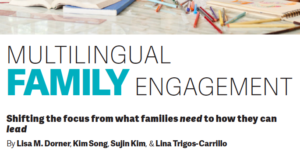
Multilingual Family Engagement

November 29, 2019 By Lisa Dorner

Migration. Whether searching for greater opportunities or enriching experiences, or escaping poverty or war, people are on the move. Worldwide, the United Nations reports that more than 250 million people do not live in the country where they were born, an increase of 49% since 2000. In the United States, the percentage of children who have at least one immigrant parent or caregiver grew from 18% to 27% between 1997 and 2017. More than 20% of households speak a language other than English. Some schools that have never served students who speak other languages now have to design English language development or bilingual education programs. (Dorner, Song, Kim, & Trigos-Carrillo, 2019)

In this recent article published in Literacy Today, colleagues and I reflected on how schools manage this kind of change, especially: How do they integrate, support, and reach out to immigrant, multilingual families? Research has long suggested that traditional family engagement in schools fails to incorporate diverse communities in meaningful and empowering ways. This contributes to ongoing marginalization based on race, ethnicity, class, language, and immigrant status. In our work with various school districts, we encourage educators to shift their thinking from what families might need to how they, themselves, can lead. In the article, we provide examples of how to host literacy days in families’ languages, what we learned, and how to work with parents as partners in developing school-wide events.

We conclude: Too often, schools view home languages and cultures as deficits, with families merely receiving information and services.  If families and classroom teachers are at the center of family engagement, they will be leaders and agents, and together we can transform our English-only and monolingual spaces to multilingual, culturally sustaining ones.

 This article originally appeared in the November/December 2019 issue of Literacy Today, the member magazine of the International Literacy Association.
Filed Under: Immigration - Immigrants, Parent Involvement, Research - Publications

What’s Dual Language Education?

September 15, 2019 By Lisa Dorner

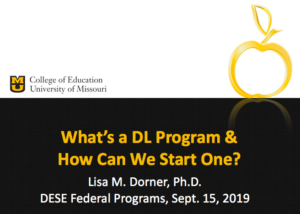
What’s a dual language (DL) program and how can you start one? This is a serious question across the United States (and world), as more and more schools are recognizing the value in preserving families’ home languages and working toward bilingualism for all students. There are many models, though a good majority of DL bilingual education programs in the U.S. mix students from two language backgrounds (for example, English and Spanish). By providing content instruction in students’ languages, DL programs develop students’ bilingualism, biliteracy, high academic achievement and cultural competencies. While it’s difficult work (see my earlier posts), we know a lot about how to create equitable programs. At a recent conference sponsored by Missouri’s Department of Elementary and Secondary Education, I devised a workshop focused on how to build a dual language program and simultaneously enhance equity for transnational students designated as English Learners. Here are my slides from that workshop – happy planning! Whats a DL Program 2019

Filed Under: Immersion Education, language policy, Presentations

Critical Consciousness in Two-Way Immersion Education

April 30, 2019 By Lisa Dorner

From research studies to school websites, it is often written that two-way dual language (TWDL) bilingual education programs share three core goals: academic achievement, bilingualism and biliteracy, and sociocultural or intercultural competence. Colleagues (Deb Palmer, Claudia Cervantes-Soon, and Dan Heiman) and I have been thinking: this isn’t enough! Building upon our research review (RRE 2017), we proposed a fourth core goal: critical consciousness.

Although TWDL programs are designed to integrate students from diverse language, culture, and race backgrounds, equity is unfortunately still a challenge. We argue that centering critical consciousness—or fostering among teachers, parents, and children an awareness of the structural oppression that surrounds us and a readiness to take action to correct it—can support increased equity and social justice in TWDL education. In our most recent publication in the journal Theory Into Practice, we elaborate four elements of critical consciousness: interrogating power, critical listening, historicizing schools, and embracing discomfort. We illustrate these elements with examples from TWDL research and practice. In addition, we describe how such consciousness impacts and radicalizes the other three core goals, in turn supporting the development of more successful, equitable, and socially just TWDL schools.

Please take a look and let us know your ideas: how might these ideas work in your bilingual school or classroom? How can this help create more equitable and welcoming educational experiences, especially for children from immigrant families?

Filed Under: Immersion Education

Immigrant Family Engagement Grows in Carthage MO

December 17, 2018 By Lisa Dorner

As part of the SEE-TEL project to strengthen equity and effectiveness in “English Learner” education in Missouri, teachers and school leaders across the state are working to enhance family engagement with multilingual, immigrant parents. One tactic is hosting family conversations among educators and parents, in small groups, where parents have a chance to share their educational perspective and experiences. In a story about Carthage School District’s participation in SEE-TEL, The Joplin Globe reported that families rarely have such opportunities. We truly need to ‘flip the script’ on typical parent programs in our schools. Rather than ask “What do we/the school need to ‘give’ to parents?” schools should more often ask families: “What would you like to share with us?”

Besides an immigrant parent panel about raising children in US schools, SEE-TEL educators attended presentations about new ways to value multiple languages and literacies at the SEE-TEL Summer Institute. About this work, Emeli Jimenez, a dual language teacher in Carthage, Missouri said: “Hearing the parent panel motivated me more to be part of this program, because it is my job to set the foundation to make sure that Spanish has a status that is higher than what it’s being given.” As someone who grew up speaking Spanish, she added: “I want to make sure that kids see me as a professional, and I want them to know and realize that Spanish is important and that people that speak it are also important and have value.” Over the next four years, SEE-TEL will study whether and how such programming shapes school climate, culture, and student outcomes; check back for updates!

Filed Under: Immigration - Immigrants, Parent Involvement

Addressing an Ever-Changing Immigration Context in Schools

September 20, 2018 By Lisa Dorner

My colleague, Emily Crawford, and I recently wrote an article for EdWeek that addressed what educators should consider in this historical moment of ever-changing immigration law and policies. As professors who help to prepare school leaders and language teachers in Missouri, we offered some practical advice in four areas: (1) What are educators’ legal and ethical responsibilities to im/migrant, refugee, and transnational students and families? (2) How can schools and teachers prepare themselves for newcomers and for situations like nearby raids from Immigrant and Customs Enforcement? (3) How can educators prepare themselves and their students to develop critical media literacy in an era of “fake news”? (4) What do we need to do to cross boundaries, develop empathy, and encourage love in our teaching and learning?

Overwhelmingly, this country is made of individuals who have traversed oceans, climbed mountains, and weathered incredible hardship to build a new life for their families. Historically, the most recent newcomers — no matter where they come from — are viewed with suspicion, but eventually they develop strong bonds with long-time residents and contribute significantly to their communities. We know we can do better than building walls; we know strong societies are integrated societies built upon frameworks of understanding and love, not gates and isolation. We depend upon schools — and ourselves — to work toward a brighter future than blurs rather than builds boundaries.

Filed Under: Immigration - Immigrants, Research - Publications

« Previous Page
Next Page »

Research Areas

  • Language Policy & Planning
  • Educational Policy Implementation
  • Immigrant Integration
  • Program Evaluation

Research Projects

  • Families & Two-Way Immersion
  • Creating One-Way Immersion
  • Language Brokering

Partners

  • Organizations
  • Research Teams