
I’ve wanted to write this post for awhile, something about integration, crossing cultures, understanding others, having difficult conversations, standing up for what is right, trying to figure out what is right — but the world has been heavy, the challenges have been many, work and family have been busy, and I have been stuck.
But now, it’s time. It’s been over two years since I promised myself that I’d try to write an essay each month, and over one year since I posted anything at all. Writing is one way to preserve history, understand what is happening, find commonality, and respond. And what a better time to do this kind of work than on Martin Luther King, Jr. Day, 2026? So, let’s begin.
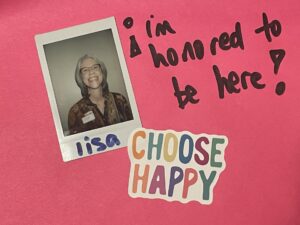
About one week ago, I was at a storytelling workshop focused on the Asian American experience in St. Louis, supported in part by the organization where I work (more on that later). During our initial activity, we were we instructed to present a “gift” related to our story, and one of the participants handed me a figurine of a goddess from her home culture, and said,
‘This is for the Other in a Room Full of Others.’
I was so struck by this statement that I asked her to repeat it, and then I repeated it myself. This statement stayed with me. In the words of another friend, this gift “said the quiet part out loud.” In just a few short words, she highlighted that I was different. Indeed, I was the only white person in the room, the only person without a mother or father or grandparent from an Asian country, and certainly, I hadn’t been the only one who had noticed that.
But this gift also invited us to remember and reflect that everyone else in the room was also an “other,” or had been othered, at some point in their lives — in fact, quite likely to a much greater extent than myself in our predominantly white region. Nonetheless, for this brief moment, even though each of our experiences and backgrounds and lives had been really different, we were brought to recognize with this short statement that, fundamentally, we all shared that otherness, or being an-other person.
Brilliant!
I carry this with me in my work, in my life. I am currently the director of a research and outreach center founded in the early 2000s by professors and community members who saw a need to understand demographic change in the Midwestern United States. They were particularly curious about the “new Latin American diaspora” settling across the Midwest and Southwest, changing predominantly mono-cultural small towns and suburbs into much more diverse places. And, now I realize, one of the most important things they did in their research and outreach over the years was to consider everyone an “other.” Their research was not only about how immigrants from Mexico or migrant farm workers from Central America were learning English, or finding homes, improving their economic circumstances, or getting to know (or not) the others in their new town. It was also about how long-term (mostly white) residents were experiencing the demographic change and getting to know (or not) their new neighbors. Ultimately, it would take the whole community together to ensure integration and well-being for all, breaking down misconceptions of the “other” from all angles being a key part of this work. That is one reason that our center is currently hosting storytelling workshops as part of a year-long festival to honor how ‘Migration Made Missouri.” We need to share our stories, to understand our pasts, to work together.
More of this work to connect and sow seeds of connection is essential at this very moment. Right now, our U.S. federal government is not in the business of promoting understanding or sharing stories; instead, they are using fear of change and immigration as their single story to drive division and sow chaos, targeting Los Angeles, Chicago, DC, Charlotte, and now, Minneapolis. We cannot let their single story define our country, and each of us must not be defined by a single story (thank you for my still-ever favorite TED talk, Chimamanda Ngozi Adichie).
I have so much admiration for all those this past year, who stood up for what was right, who told their stories, who loved their neighbors, and who protested what was wrong in the cold and in the rain. We must keep it up. Indeed, we are all others in a world full of others, and we must continue to show up for one an-other.